3 x 10 swings, 3x/week
1 · Evidence theater
See it in your swing
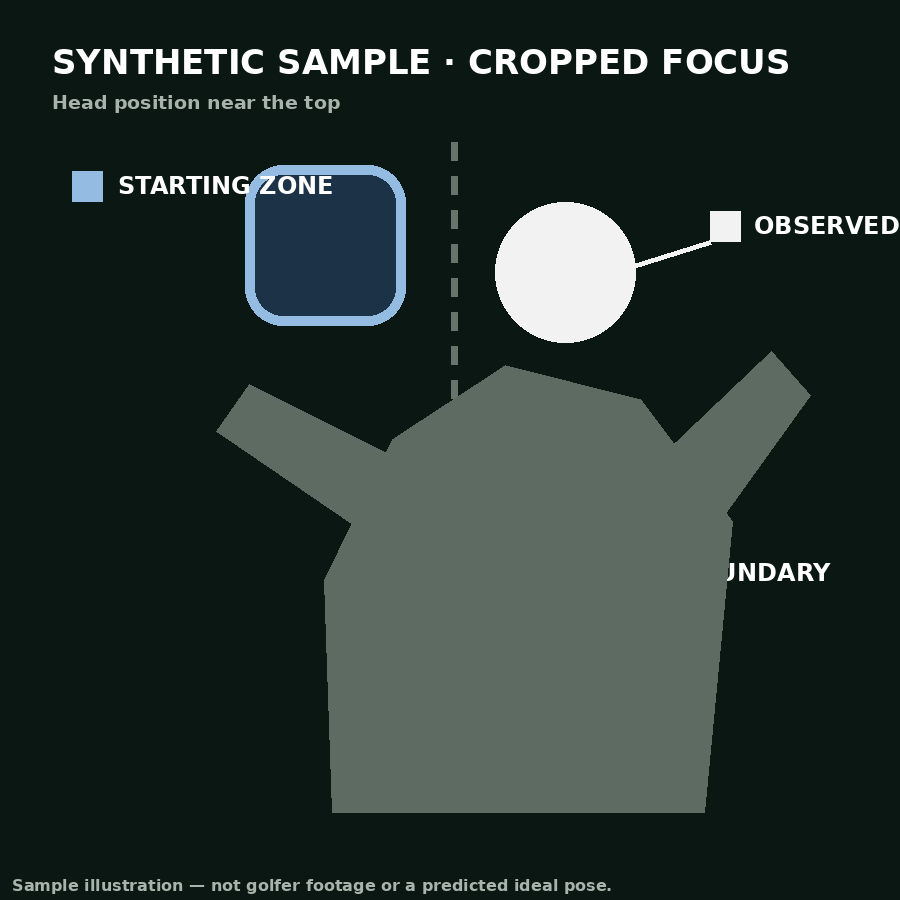
Observed: Head position near the top
Starting reference: Starting head-position zone
Coaching boundary: 0.35 shoulder-width coaching boundary
Tracking: Clear
The head moved beyond its starting reference zone on two of three readable swings.
Observed and reference marks are 2D phone-video evidence, not a personalized ideal pose.
- Detected:
- 3
- Readable:
- 3
- Triggered:
- 2
- P4Top estimate Top from highest hand position
See measurement
Head movement going back: 0.37 shoulder widths
Configured line: 0.35
This is the head's sideways movement from setup to the top.
Single-camera measurement; re-film face-on for this detail.
Setup Baseline
Context for comparable re-films — match this next session.
3 readable swings
Going back Priority
Your caddie priority — the clearest lever in this clip.
3 readable swings
Transition & downswing Review later
A secondary measured issue waits after the priority feels solid.
3 readable swings
Impact Steady
Measured values hold steady in this phone-video read.
3 readable swings
Finish Steady
Measured values hold steady in this phone-video read.
3 readable swings
What this video can measure
- Setup context only; it is not graded good or bad.
- Timing is estimated from the detected swing events.
- Single-camera measurement; re-film face-on for this detail.
- Context only, not clubhead speed or ball speed.
- Impact is estimated, not directly observed.
- Camera-view angle only; it is not a 3D joint angle.
- It measures base drift, not every foot movement or pressure shift.
Measured this session
| Metric | This clip | Noise floor |
|---|---|---|
| Stance width | 0.96 sw | — |
| Backswing time | 0.81 s | — |
| Head movement going back | 0.37 sw | ±0.03 |
| Hip movement going back | 0.22 sw | ±0.03 |
| Tempo ratio | 2.4:1 | ±0.1 |
| Downswing time | 0.34 s | — |
| Hand movement | 4.83 sw/s | — |
| Estimated impact | 9.80 s | — |
| Head dip | 0.09 sw | ±0.03 |
| Lead-arm shape | 168° | ±3 |
| Shoulder tilt | 13° | ±3 |
| Finish-base stability | 0.06 sw | ±0.03 |
Stance width 0.96 sw
- Noise floor
- —
Backswing time 0.81 s
- Noise floor
- —
Head movement going back 0.37 sw
- Noise floor
- ±0.03
Hip movement going back 0.22 sw
- Noise floor
- ±0.03
Tempo ratio 2.4:1
- Noise floor
- ±0.1
Downswing time 0.34 s
- Noise floor
- —
Hand movement 4.83 sw/s
- Noise floor
- —
Estimated impact 9.80 s
- Noise floor
- —
Head dip 0.09 sw
- Noise floor
- ±0.03
Lead-arm shape 168°
- Noise floor
- ±3
Shoulder tilt 13°
- Noise floor
- ±3
Finish-base stability 0.06 sw
- Noise floor
- ±0.03
sw = shoulder widths. Changes inside the noise floor are shown but not called improved.
2 · Today's training
Stick outside the trail foot
Turn behind the ball instead of drifting off it.
- Place a leaning stick safely outside the trail foot, clear of the club path.
- Rehearse slow turns that stay clear of the stick while pressure loads inside the trail foot.
- Hit at 80 percent effort and stop if the body or club can contact the stick.
Turn into the trail hip — pressure inside, head quiet.
- Setup
- Turf station with the stick outside and behind the swing arc.
- Feel cue
- Turn into the trail hip — pressure inside, head quiet.
- Dosage
-
Session dosage 3 x 10 swings, 3x/week
- Equipment
- Alignment stick
Optional aid for this drill: Matched training aid
Full drill steps
- Push an alignment stick into the ground just outside your trail foot, leaning slightly toward you.
- Make slow backswings — brushing the stick means the body is drifting, not turning.
- Feel pressure load into the inside of the trail foot at the top.
- Hit balls at 80% effort while staying clear of the stick.
Try a different drill · 4
Mirror head box
Give the eyes proof of a quiet head before the ball does.
Three-beat count
Give the backswing time to finish before the downswing starts.
Late whoosh
Move the swing's speed to the bottom of the arc instead of the top.
Pause at the top
Separate going back from coming down so the transition stops rushing.
3 · Prove it
Repeat the same test
- Use the same club, hand, camera angle, height, framing, and effort.
Pass mark
Keep the session at or below 0.35 shoulder widths.
Pass mark · next matched re-film
0.35 shoulder widths
Now 0.37 Mark 0.35
- Same club
- Confirmed
- Same hand
- Confirmed
- Same camera angle
- Confirmed
- Same camera height
- Confirmed
- Same framing
- Confirmed
- Same effort
- Confirmed
Every swing · 3
Swing 1
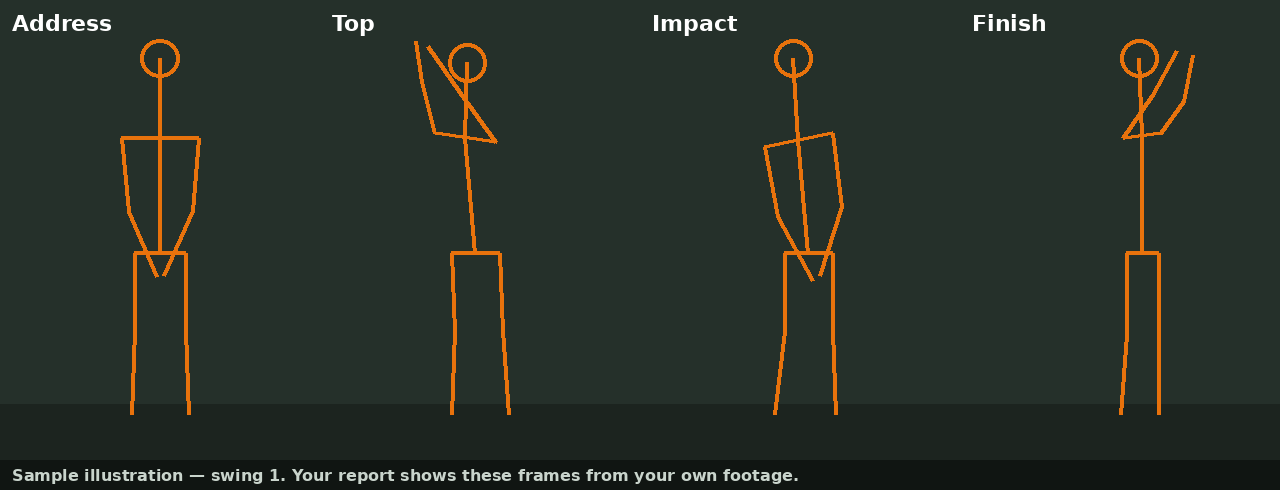
- Head sways 0.41 shoulder widths away from the target going back (flagged beyond 0.35). Feel like the head stays inside the trail foot at the top.
- Tempo ratio 2.3:1 is quicker than the 2.4 threshold (tour average is about 3.0:1 with a downswing near 0.25 s). Let the backswing finish before starting down.
- Estimated impact
- 3.20 seconds
- Backswing time
- 0.78 seconds
- Downswing time
- 0.34 seconds
- Tempo ratio
- 2.3:1
- Head movement going back
- 0.41 shoulder widths
- Hip movement going back
- 0.22 shoulder widths
- Head dip
- 0.08 shoulder widths
- Lead-arm shape
- 168 degrees
- Shoulder tilt
- 13 degrees
- Finish-base stability
- 0.06 shoulder widths
- Stance width
- 0.96 shoulder widths
- Hand movement
- 4.82 shoulder widths per second
Swing 2
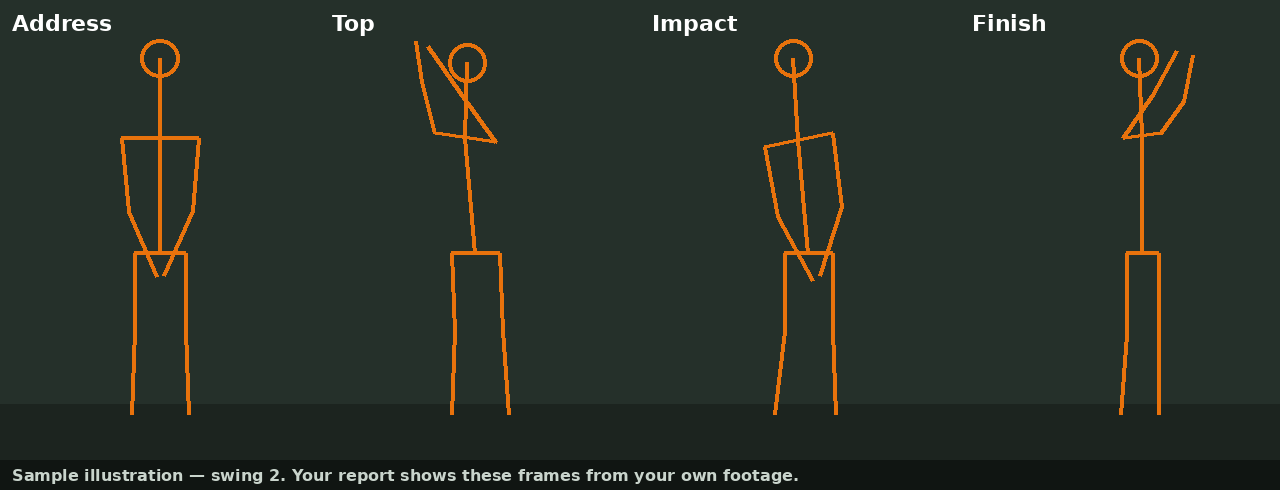
- Head sways 0.38 shoulder widths away from the target going back (flagged beyond 0.35). Feel like the head stays inside the trail foot at the top.
- Tempo ratio 2.3:1 is quicker than the 2.4 threshold (tour average is about 3.0:1 with a downswing near 0.25 s). Let the backswing finish before starting down.
- Estimated impact
- 9.80 seconds
- Backswing time
- 0.81 seconds
- Downswing time
- 0.35 seconds
- Tempo ratio
- 2.3:1
- Head movement going back
- 0.38 shoulder widths
- Hip movement going back
- 0.19 shoulder widths
- Head dip
- 0.11 shoulder widths
- Lead-arm shape
- 171 degrees
- Shoulder tilt
- 12 degrees
- Finish-base stability
- 0.04 shoulder widths
- Stance width
- 0.98 shoulder widths
- Hand movement
- 4.91 shoulder widths per second
Swing 3
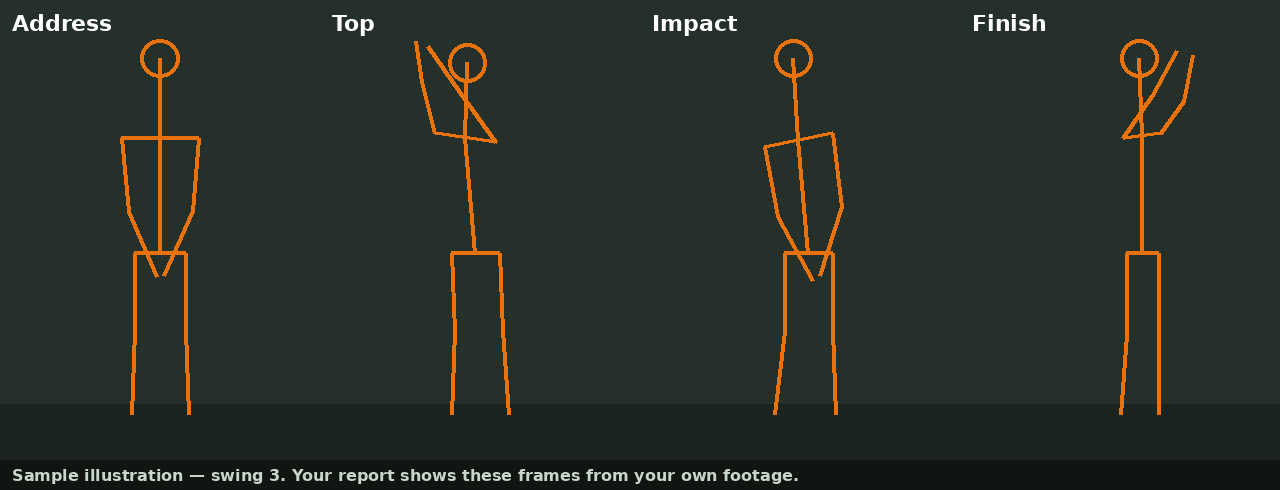
- No measured coaching value crossed its configured threshold on this swing.
- Estimated impact
- 16.40 seconds
- Backswing time
- 0.84 seconds
- Downswing time
- 0.33 seconds
- Tempo ratio
- 2.5:1
- Head movement going back
- 0.33 shoulder widths
- Hip movement going back
- 0.24 shoulder widths
- Head dip
- 0.09 shoulder widths
- Lead-arm shape
- 166 degrees
- Shoulder tilt
- 14 degrees
- Finish-base stability
- 0.07 shoulder widths
- Stance width
- 0.95 shoulder widths
- Hand movement
- 4.76 shoulder widths per second
Swing Pattern · 4
Mostly centered swing
Across 3 measured swings, this session reads as turning with some slide with a mobile head.
- Lower body
- Turning with some slide — The hips travel 0.22 shoulder widths going back, under the 0.35 line but not by much: a turn with some lateral movement in it.
- Head stability
- Mobile head — The head moves 0.37 SW sideways (line 0.35) and 0.09 SW down (line 0.25), reaching or passing its line. The head travels with the swing rather than staying put.
- Tempo character
- Quick transition — The backswing takes 2.38 times the downswing, under the 2.4:1 line — the change of direction is hurried relative to the 3.0:1 reference.
- Finish
- Held finish — The ankle midpoint drifts 0.06 shoulder widths through the hold, inside the 0.15 line — the finish is held.
Not readable from this clip: Downswing sequence.
Axes the clip could not measure are listed rather than guessed.
Secondary findings · 1
Tempo
2.38:1
A backswing that never finishes forces the downswing to start from a moving platform, and everything after that is timing. The 3:1 ratio is not magic — it is simply the range where the swing has time to change direction.
Cue: Rehearse one count until it is boring — metronome or out loud — then keep that clock when you add a ball.
More strengths · 6
Hip slide
Hip slide stays at 0.24 shoulder widths or less in the backswing — inside the 0.35 line. The hips are turning, not drifting.
Head dip
Head dip tops out at 0.11 shoulder widths into impact — inside the 0.25 line. Height is holding through the strike.
Lead arm
Lead arm stays at 166° or straighter at impact (180° is straight) — width through the ball is there.
Shoulder tilt
Shoulder tilt holds at 12° or more at impact — the trail shoulder is working down through the ball.
Finish balance
Finish drift stays at 0.07 shoulder widths or less — the swing is ending somewhere the body can hold. Keep holding every finish.
Swing-to-swing consistency
Tempo is consistent swing to swing (±0.12) — same clock every time. That's an asset worth protecting.
Measurements · 12
| Item | Value |
|---|---|
| Hand | right |
| Camera angle | face_on |
| Detected swings | 3 |
| Duration | 21.00 seconds |
| Display size | 1080 x 1920 |
| Rotation metadata | 0 degrees |
| Source frame rate | 30 fps |
| Stance width | 0.96 shoulder widths |
| Backswing time | 0.81 seconds |
| Head movement going back | 0.37 shoulder widths |
| Hip movement going back | 0.22 shoulder widths |
| Tempo ratio | 2.4:1 |
| Downswing time | 0.34 seconds |
| Hand movement | 4.83 shoulder widths per second |
| Estimated impact | 9.80 seconds |
| Head dip | 0.09 shoulder widths |
| Lead-arm shape | 168 degrees |
| Shoulder tilt | 13 degrees |
| Finish-base stability | 0.06 shoulder widths |
Stance width
0.96 shoulder widths
This is your setup reference for comparable re-films.
Setup context only; it is not graded good or bad.
Backswing time
0.81 seconds
This is the measured time from takeaway to the top.
Timing is estimated from the detected swing events.
Head movement going back
0.37 shoulder widths
This is the head's sideways movement from setup to the top.
Single-camera measurement; re-film face-on for this detail.
Hip movement going back
0.22 shoulder widths
This is the hips' sideways movement from setup to the top.
Single-camera measurement; re-film face-on for this detail.
Tempo ratio
2.4:1
This compares backswing time with downswing time.
Timing is estimated from the detected swing events.
Downswing time
0.34 seconds
This is the measured time from the top to estimated impact.
Timing is estimated from the detected swing events.
Hand movement
4.83 shoulder widths per second
This is projected hand movement during the downswing.
Context only, not clubhead speed or ball speed.
Estimated impact
9.80 seconds
This is the estimated time of impact in the swing window.
Impact is estimated, not directly observed.
Head dip
0.09 shoulder widths
This is the measured head drop from setup to impact.
Single-camera measurement; re-film face-on for this detail.
Lead-arm shape
168 degrees
This is the lead-arm angle at estimated impact.
Camera-view angle only; it is not a 3D joint angle.
Shoulder tilt
13 degrees
This is shoulder tilt at estimated impact.
Camera-view angle only; it is not a 3D joint angle.
Finish-base stability
0.06 shoulder widths
This is ankle-midpoint drift during the finish hold.
It measures base drift, not every foot movement or pressure shift.
- Setup context only; it is not graded good or bad.
- Timing is estimated from the detected swing events.
- Single-camera measurement; re-film face-on for this detail.
- Context only, not clubhead speed or ball speed.
- Impact is estimated, not directly observed.
- Camera-view angle only; it is not a 3D joint angle.
- It measures base drift, not every foot movement or pressure shift.
Glossary · 13
- Stance width
- This is your setup reference for comparable re-films.
- Backswing time
- This is the measured time from takeaway to the top.
- Head movement going back
- This is the head's sideways movement from setup to the top.
- Hip movement going back
- This is the hips' sideways movement from setup to the top.
- Tempo ratio
- This compares backswing time with downswing time.
- Tempo consistency
- This is the swing-to-swing spread in tempo ratio.
- Downswing time
- This is the measured time from the top to estimated impact.
- Hand movement
- This is projected hand movement during the downswing.
- Estimated impact
- This is the estimated time of impact in the swing window.
- Head dip
- This is the measured head drop from setup to impact.
- Lead-arm shape
- This is the lead-arm angle at estimated impact.
- Shoulder tilt
- This is shoulder tilt at estimated impact.
- Finish-base stability
- This is ankle-midpoint drift during the finish hold.
Gear · 1
Matched training aid
Needs one alignment stick pushed into turf; at home, a doorframe or a chair back beside the trail hip works.
View gear